Why Every Artist Needs a Brand Strategy: F.A.M.E.'s Blueprint for Entertainment Success
F.A.M.E March 15, 2026 6 min read 478 views
Most talented artists never break through. Not because of a lack of skill, but because talent alone has never been enough in the entertainment industry. What separates the artists who build lasting careers from those who fade after a moment in the spotlight is something less glamorous than raw ability — it is a deliberate, well-executed brand strategy.
F.A.M.E. (Fletcher Artist Management Enterprises), the Los Angeles-based artist management and entertainment brand development firm founded by Ian Fletcher in 2003, has spent more than two decades proving this point. Their work with multi-Grammy nominated act LMFAO — culminating in a performance at the Super Bowl XLVI Halftime Show alongside Madonna — is one of the most instructive case studies in modern music industry branding. Here is what aspiring artists and managers can learn from their blueprint.
What Is Artist Brand Strategy and Why Does It Matter?
An artist's brand is not just their logo, their social media aesthetic, or the genre listed on their Spotify profile. It is the complete emotional and cultural identity that audiences attach to a name. It is the answer to the question: When people hear your name, what do they feel?
Without intentional brand development, that answer is left to chance. With it, every piece of content, every collaboration, every live performance, and every public appearance reinforces a single coherent story. That story is what builds fan loyalty, attracts major opportunities, and sustains a career beyond a single hit.
In an era where millions of tracks are uploaded to streaming platforms every week, music industry branding is no longer optional — it is the primary competitive advantage available to independent artists.
The F.A.M.E. Framework: Four Pillars of Entertainment Brand Development
F.A.M.E.'s mission — Discovering, Developing and Building World-Class Entertainment Brands — makes the philosophy explicit. Notice that the word "brand" is central, not "career" or "talent." That framing is intentional, and it shapes how the firm approaches every artist on their roster.
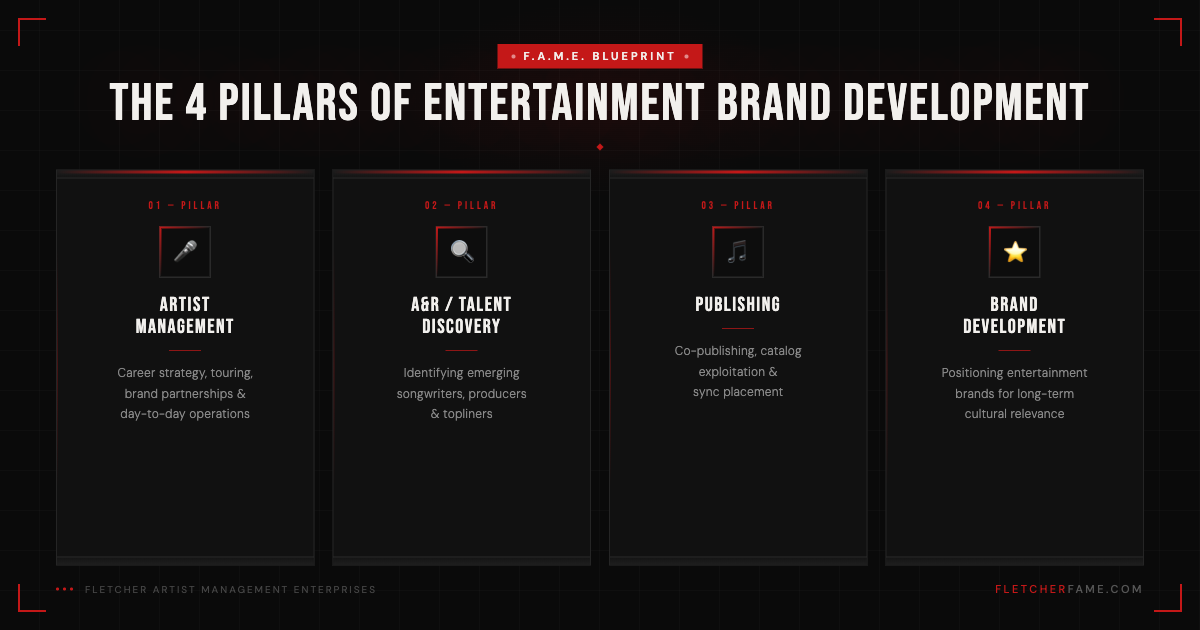
Their core service areas map directly to four foundational pillars any serious artist should be building:
1. Artist Management
Effective artist management means more than booking shows and negotiating contracts. A strong manager functions as a brand architect — someone who sees the long-term vision clearly enough to turn down short-term opportunities that do not serve it. When F.A.M.E. worked with LMFAO, the goal was never just chart placement. It was positioning an act that could command a Super Bowl Halftime stage alongside one of the biggest pop icons in history. That kind of trajectory requires management with strategic discipline, not just deal-making hustle.
2. A&R and Talent Discovery
A&R (Artists and Repertoire) is the process of identifying raw talent and shaping it into something the market is ready to receive. This is a skill that requires both creative instinct and commercial awareness. F.A.M.E.'s current publishing partnerships through The Royalty Network — working with emerging talent including Dody6, Taylor Graves, Zulia, Angel Hill, and Dale Pututi — reflect a continued commitment to this developmental work at the earliest stages of an artist's journey.
For aspiring artists, the takeaway is clear: finding the right A&R partner early can compress years of trial and error into months of focused development.
3. Publishing
Music publishing is one of the most misunderstood and undervalued assets in an artist's portfolio. Publishing deals control the licensing, synchronization, and performance rights of the underlying compositions — which means they determine how and when songs generate income over their lifetime. Artists who treat publishing as an afterthought routinely leave significant revenue on the table.
Grammy-winning producer Play-N-Skillz and solo artist Redfoo, both associated with the F.A.M.E. roster, represent the kind of established talent where publishing relationships translate directly into sustained royalty income. Building those structures early is a mark of professional brand management.
4. Brand Development
This is where entertainment branding becomes most visible — and most misunderstood. Brand development is not about creating a persona that feels inauthentic. It is about identifying what is genuinely distinctive about an artist and amplifying it consistently across every touchpoint.
LMFAO's Party Rock aesthetic was not accidental. The visual language, the energy, the humor, the specific flavor of excess and absurdity that defined their public image — all of it was cohesive. Audiences knew exactly what they were getting, and that clarity of identity is what allowed a single like "Party Rock Anthem" to become a global phenomenon rather than a regional curiosity.
Lessons for Independent Artists and Managers
You do not need a major label deal to begin thinking like a brand. In fact, independent artists today have more direct access to their audience — and therefore more direct control over their brand narrative — than at any previous point in the industry's history. Here are the most actionable principles to take from the F.A.M.E. approach:
- Define your identity before your release strategy. Know what you stand for, who your audience is, and what emotional space you occupy before you start pushing content. Every decision after that becomes easier.
- Surround yourself with people who think strategically, not just creatively. Great producers, great musicians, and great songwriters are easier to find than great strategists. The people guiding your brand development need to understand business as fluently as they understand art.
- Treat publishing as an asset, not an afterthought. Register your compositions, understand your rights, and seek professional guidance on licensing and sync opportunities from the beginning.
- Consistency compounds. Brand equity is built through repetition. Every time an audience encounters your name and it reinforces the same feeling, you are making a deposit into a trust account that pays dividends over years and decades.
- Big moments are built, not stumbled into. A Super Bowl Halftime Show does not happen by accident. It is the result of years of consistent brand positioning that makes an act feel like the right fit for the world's largest stage.
Why the Right Management Partner Changes Everything
The entertainment industry moves fast, and the difference between a career and a flash in the pan often comes down to the quality of the team around an artist at the critical early stages. A management firm with genuine industry relationships, a track record of developing talent across multiple genres, and a clear philosophical commitment to brand-first thinking is genuinely rare.
What firms like F.A.M.E. bring to the table is not just access — it is a proven methodology for turning artistic potential into durable commercial success. More than twenty years of work in Los Angeles, across genres, and at the highest levels of the industry, provides a depth of pattern recognition that simply cannot be replicated by newer entrants.
Rich Boy and Shawty Redd represent the breadth of that roster experience — artists operating in very different sonic spaces, but all unified by the same underlying approach to brand building and career development.
Building a World-Class Entertainment Brand Starts With One Decision
The most important decision an aspiring artist or entertainment entrepreneur can make is the decision to take their brand seriously before they feel famous enough to justify it. The artists who wait until they have a hit to think about brand strategy are the ones most likely to watch that hit fade without a foundation built to sustain what comes next.
The framework is not complicated. Define your identity. Develop your catalog with intention. Protect your publishing. Align yourself with management that understands the long game. And find partners who have already done what you are trying to do.
If you are an artist, manager, or entertainment entrepreneur ready to take brand development seriously, learn more about the work being done at Fletcher Artist Management Enterprises and explore what a strategic partnership could look like for your career.